Which Chinese measure words do you actually need?
Learn 个 and about thirty more as you meet them; the long lists can wait.
We make Mandarin The Wild.
What a measure word is
In Chinese a number, 这 or 那 usually can't go straight before a noun. A measure word goes between them: 一本书 (a book), 三杯咖啡 (three cups of coffee), 这位老师 (this teacher). Each noun has the ones it takes, mostly by its shape or kind: 张 for flat things, 条 for long ones, 位 for people you are polite about.
中文的量词多吗?
(grammar) measure word; classifier
Also written 量詞
How often they come up
We counted every measure word that follows a number, 这, 那, 哪, 每 or 几 in two kinds of Chinese: the speech in 292 films and shows made in Mandarin, and 28,363 sentences of written Chinese from the web, from news and reviews to fiction and government pages.1
| Kind of Chinese | Measure words per 1,000 words | Share that are 个 | Measure words that make up 90% of uses |
|---|---|---|---|
| Film and TV speech | 15.6 | 50% | 31 |
| Writing | 16.4 | 38% | 40 |
That is about one measure word in every 60 words, and half of them, on screen, are 个. After 个, speech uses 次 (times), 种 (kinds), 块 (pieces, and yuan), 位, 件, 条 and 张; writing uses 种, 次, 家 (for businesses), 名 and 位 (for people), 条 and 座 (for buildings and mountains).
You don't need the long lists
Our measure word finder knows 117 measure words. 31 of them cover 90% of those spoken in films and shows, and most of the rest are for one or two nouns each: 盏 for lamps, 艘 for ships, 炷 for sticks of incense. You can learn those when you meet the lamp.
The 31 measure words to teach first
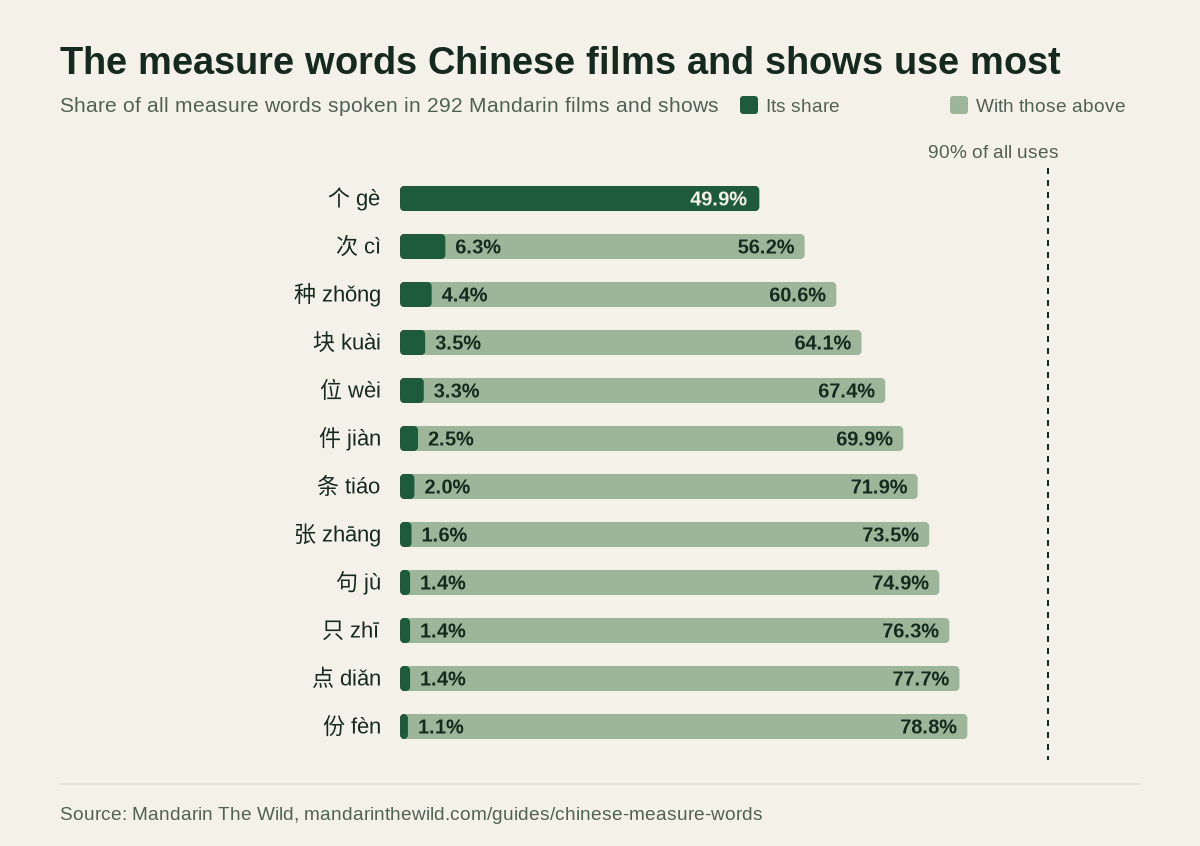
These are the measure words that make up 90% of those spoken in Chinese films and shows, most used first. 个 alone is half; the first 12 make up 78.8%.
| Measure word | What it counts | Share of spoken measure words |
|---|---|---|
| 个 gè | people and most things | 49.9% |
| 次 cì | times and occurrences | 6.3% |
| 种 zhǒng | kinds and types | 4.4% |
| 块 kuài | pieces, lumps, chunks | 3.5% |
| 位 wèi | people | 3.3% |
| 件 jiàn | clothes, matters and items | 2.5% |
| 条 tiáo | long thin things, rivers, roads, fish, messages, news and items | 2.0% |
| 张 zhāng | flat objects | 1.6% |
| 句 jù | phrases and lines of speech or verse | 1.4% |
| 只 zhī | animals, one of a pair, boats and some containers | 1.4% |
| 点 diǎn | o’clock (三点), and points | 1.4% |
| 份 fèn | portions, copies of newspapers, documents and gifts | 1.1% |
| 家 jiā | businesses and families | 1.0% |
| 把 bǎ | things with a handle, chairs and handfuls | 0.9% |
| 场 chǎng | sports events, shows and exams | 0.9% |
| 杯 bēi | cups or glasses of drink | 0.9% |
| 趟 tàng | trips or runs | 0.7% |
| 段 duàn | sections, passages and stretches of time or road | 0.6% |
| 套 tào | sets, suites and series | 0.6% |
| 颗 kē | small round things | 0.6% |
| 片 piàn | slices, tablets, stretches of land, scenes and feelings | 0.5% |
| 间 jiān | rooms | 0.5% |
| 首 shǒu | songs and poems | 0.5% |
| 声 shēng | sounds | 0.5% |
| 部 bù | films, books and vehicles | 0.5% |
| 本 běn | books | 0.5% |
| 根 gēn | long thin objects | 0.5% |
| 口 kǒu | family members, mouthfuls and wells | 0.4% |
| 支 zhī | troops, songs, pens and long thin things | 0.4% |
| 碗 wǎn | bowls of food | 0.4% |
| 名 míng | people | 0.4% |
The chart and list are free to use in class or on your own site, with a link back to this page.
个 is not a mistake, but it is not the whole answer
When a noun has its own measure word, native speakers use it most of the time, but not always. For nouns whose dictionary measure word is not 个, the next word after the measure word was:
| Kind of Chinese | Its own measure word | 个 | Another one |
|---|---|---|---|
| Film and TV speech | 66% | 17% | 17% |
| Writing | 63% | 16% | 21% |
"Another one" is spread over many, led by 种 (kinds) and 次 (times), which say something different: 三种书 is three kinds of book. Some nouns lean on 个 even on screen: 老师 came after 个 six times and after 位 twice. Others almost never do: 书 came after 本 38 times and after 个 twice.
Learners lean on 个 more than that. Comparing English-speaking learners with native speakers on the same tasks, a study found that learners relied heavily on 个 and used fewer specific measure words, and that what held them back was knowing the words, not the grammar.2
A plan that fits the evidence
- Use 个 when you don't know, and keep talking. You will be understood, and native speakers use it too.
- Learn the noun with its measure word. Not 书 but 一本书. Point at any noun in the Library or on a page with Mandarin The Wild, and save the pair to your Backpack.
- Look one up when you need it. The measure word finder gives any noun its measure words and what each is used for.
How we counted
Film and TV speech is the subtitles of the 292 OpenSubtitles titles whose original language is Mandarin, 1.76 million words.1 Writing is 531,185 words in 28,363 simplified sentences of news, reviews, fiction, encyclopedia, business, government and other web pages. Both are cut into words by our engine. A measure word counts where it follows a number, 这, 那, 哪, 每 or 几, on its own (三 本) or as one word (这个); words such as 一样 (the same), 一起 (together) and 一点 (a little) are left out. The measure words and each noun's own are our measure word finder's. "Next word" counts only a noun right after the measure word, and leaves out 钱, since in 五块钱 块 is the price in yuan.
Questions
What is the most common Chinese measure word?
个. In our count it is half of all measure words spoken in Chinese films and shows and 38% of those in written Chinese.
How many Chinese measure words do I need to know?
About 30 cover 90% of the measure words you will hear in films and shows, and 40 cover 90% of those you will read. Learn the rest as you meet them.
Can I just use 个 for everything?
You will be understood, and native speakers use 个 about one time in six even for nouns with their own measure word. But they use the noun's own one about two times in three, so learn it with the noun.
Sources
Checked on 26 October 2026. Prices and features change; tell us if one has.